Line 01
Furnaces, boilers and the ductwork we fabricate to feed them
Central forced air, hydronic, radiant and infrared, furnace and boiler systems, and every fitting the run needs, cut in our own sheet metal shop rather than pulled off a shelf.
Chapter 01
What a furnace does before it quits
A furnace rarely fails without warning. It tells you first, usually in the order most homeowners actually meet it. A system starts short cycling, running for a few minutes and shutting off before the house catches up. A flame sensor fouls with a film of carbon and starts reading a fire that is not really there, so the burner stutters. A heat exchanger cracks somewhere inside the cabinet, and the furnace either shuts itself down on a safety switch or, worse, keeps running. Last, a blower runs with no heat behind it: air moving, house getting colder.
The furnace that finally quits on the coldest night of the year has usually been saying one of these things for a fortnight. The service call that catches it in week one is a repair. The one that waits for week three is a furnace.
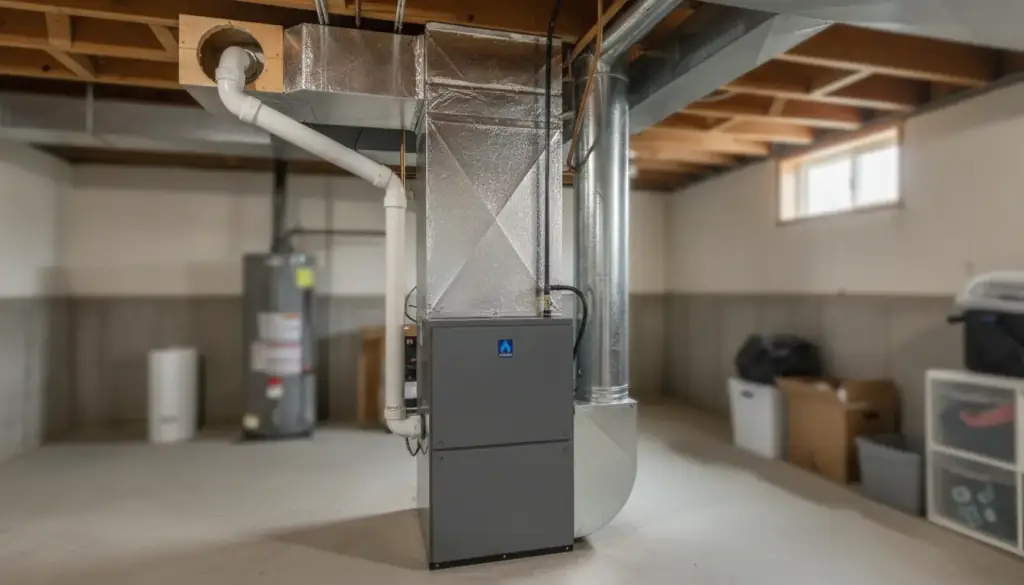
A high-efficiency gas furnace in a basement mechanical room with its galvanized supply plenum squared off into the joists
Forced air, hydronic, radiant: which one your building already wants
The building tells you most of this before a quote gets written. Ductwork already in the joists points toward forced air, and staying there is usually the honest answer on a retrofit. No ductwork and a slab floor points toward radiant or hydronic, run through the floor or through baseboards and, on the smaller end, towel warmers. New construction is the one case where every option is still open, because nothing has to be cut to fit an existing house.
A detached shop or garage is its own case. Infrared and unit heating both earn their keep there: a space that is cold most of the day and needs to come up fast when someone is actually working in it, rather than a house held at one temperature around the clock. We will tell you plainly when a system you are asking for is the wrong fit for the space, not just quote what was requested.
Chapter 03
The ductwork is the half nobody prices
Behind the service trucks sits a 6,000 square foot sheet metal shop, running light gauge sheet through thick steel plate in aluminum, copper, galvanized, colored and stainless. Most shops our size buy a fitting off a shelf and cut the job to suit it. When a transition does not fit the joist bay, or a run has to turn twice in a space that was never meant to carry ductwork, we fabricate the fitting the job actually needs instead of forcing a stock part into it.
Certified fire dampening is part of that same shop work: a damper built into the run where code calls for one, fabricated and fitted rather than bolted on as an afterthought. On an awkward retrofit, that is usually the difference between a duct run that fits and one that gets forced.
After it is in
Estimates are free, and the estimator who prices the job is the one who comes out to look at it. The work carries a one-year workmanship warranty on top of whatever the manufacturer backs the equipment for, and if something we installed is not right, we come back and fix it at no charge. Heating goes down at whatever hour it wants to, so emergency repair runs twenty-four hours, every day of the year.
Humidification and filtration are the natural follow-on once a heating system is in: a house that is warm but dry all winter, or a furnace pulling air through a filter that has not been sized for it, is still an unfinished job. Both are part of the same visit, not a separate sale.
Certified — Bonded and insured. One-year workmanship warranty. Call (715) 834-5409.
Everything on this line
Heating work we do
- Central forced air
- Unit heating
- Infrared heating
- Hydronic heat, from baseboards through towel warmers
- Radiant heating
- Sheet metal fabrication
- Ventilation and filtration
- Furnace and boiler systems
- Certified fire dampening
- Design-build services
- Humidification