Line 04
Septic and well work, found before it is dug up
Camera service with a locator so we open one hole instead of a yard, snaking and power jetting, constant and conventional well pump work, and septic installation, testing and service. Free estimates, 24-hour emergency service.
Chapter 01
Slow, then backed up: how a line actually fails
A sewer line rarely fails all at once. Grease and paper build up along the bottom of the pipe a little at a time until a slow drain becomes a backed-up one. Roots find a joint through the smallest gap and grow into a net that catches everything behind it. A run that has settled and bellied in the middle holds water and solids in the low spot no matter how often it drains.
Wisconsin adds its own version every February: a lateral that freezes at a spot too shallow for the ground it sits in, and stops draining on the coldest week of the year. We see that pattern often enough that it has a shape we recognize before the camera even goes in.
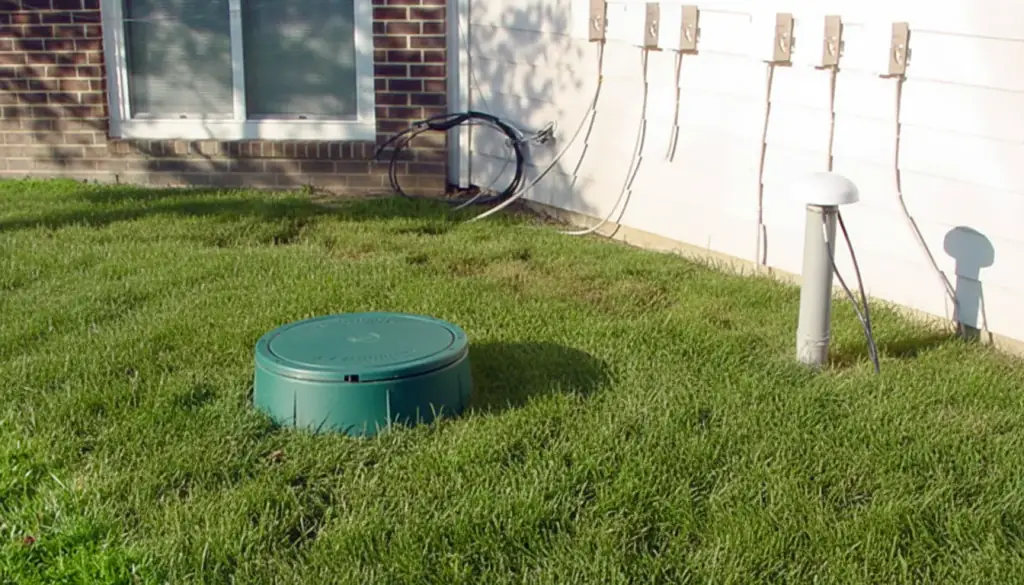
A green septic tank access lid set flush in a mown back yard with a well head casing behind it
We look before we dig
Camera service with a locator is the whole point of doing this properly. We run the camera through the line, find the fault, and mark its exact position on the surface from the locator signal, so the crew opens one hole instead of the yard. That single difference is usually the difference between an afternoon and a week.
Snaking and power jetting are the two tools for clearing what the camera finds, and they are not interchangeable. Snaking breaks through a blockage and pulls roots. Power jetting scours the inside of the pipe clean with high-pressure water, which is the better call on a line coated in grease or scale rather than blocked by one obstruction. We pick the tool the line actually needs.
Chapter 03
Well pumps, constant and conventional
A constant-pressure well system holds one steady pressure at every fixture in the house, hot or cold, upstairs or down, instead of the pressure swing a conventional tank system allows between pump cycles. Symptoms of a pump or pressure tank on the way out tend to show up as that swing getting worse: pressure that drops when a second fixture runs, a pump that short-cycles, or water that sputters before it settles.
We handle constant and conventional well pump installation and service, and a well visit is rarely just the pump. “We want you to know that we are very pleased with the work performed to correct our well leak and the relocation of our hot water heater, neutralizer, and pressure tank. What a great crew you have!” Dan and Karen M. wrote after exactly that kind of visit, where the well, the water heater, the neutralizer and the pressure tank all got handled in one trip instead of four separate trades.
Septic, from install to the next inspection
Septic tank installation, testing and service covers the system from the ground up: a new tank set and tested, or an existing one checked, pumped and kept in the condition that gets it through inspection rather than flagged by one. Routine service is the cheap side of septic ownership. A drain field that fails from neglect is the expensive side, and it is the one routine testing is meant to prevent.
Free estimates apply here the same as everywhere else we work, and if a line backs up or a septic system fails outside office hours, the emergency line runs 24 hours, every day of the year.
Certified — Bonded and insured. One-year workmanship warranty. Call (715) 834-5409.
Diagnostic and pump work
Found with a camera, not a shovel
- Snaking and power jetting
- Camera service with locator
- Constant well pump installation and service
- Conventional well pump installation and service
- Septic tank installation, testing and service
Day or night
Emergency service, 24 hours
- Frozen sewer lines
- Plugged sewer lines
- Storm sewer lines