Hard water, orange stains and blue-green joints: reading what your well is doing to the house
Three symptoms in three different rooms are usually the same well telling you three different things.
September 15, 2026 · 4 min read
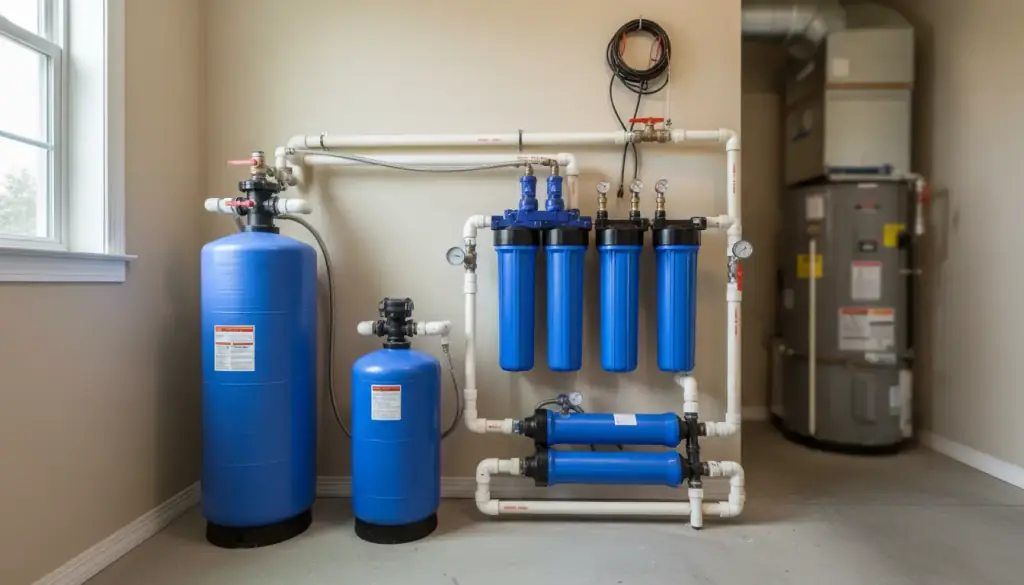
Three symptoms show up in different rooms of the house and look unrelated: a water heater losing capacity, rust-colored stains in the tub, and a greenish crust on a copper fitting under the sink. They are usually the same well telling you three different things about hardness, iron and pH, and the fix for one is not the fix for the others.
What hard water actually does to a water heater
Hardness is calcium and magnesium dissolved in the water, and it does not go away when the water gets hot. It comes out of solution and settles as scale on the hottest surface it can find, which in a water heater is the heating element or the bottom of the tank. Scale is a poor conductor of heat, so the heater has to run longer to deliver the same temperature, and on a gas water heater a scale layer at the bottom insulates the burner from the water it is supposed to be heating. The practical result is a water heater that runs more, recovers slower after a full tub, and reaches the end of its working life years earlier than the same unit would on softened water.
Iron is the orange stain, and it is not just cosmetic
Iron dissolved in well water is invisible coming out of the tap and turns orange to reddish brown once it hits air, which is why the staining shows up in the toilet bowl, the tub and on white fixtures rather than in a glass of water. It also builds up inside pipes and fixtures over time the same way it stains the porcelain, narrowing the inside diameter of a pipe and fouling the moving parts of a faucet or a softener valve. A house on a well with visible iron staining is a house where every fixture is quietly working harder than it should.
Low pH is why the copper joints are turning blue-green
Water on the acidic side of neutral is corrosive to copper, and the blue-green crust that shows up at a soldered joint under a sink is copper corrosion product, not dirt. Left alone, low pH water slowly eats at copper pipe and fittings from the inside, and in a house with copper supply lines that is a slow leak risk that usually announces itself years later as a pinhole leak inside a wall, not as a visible joint. It is also hard on any brass or copper fitting in a water heater or a softener, which is why a system installed without correcting pH first tends to have a shorter life than the same system installed after the water was tested.
Why a free water test picks the equipment, not a salesman
Hardness, iron and low pH each need a different piece of equipment: a softener addresses hardness, an iron filter addresses iron, and an acid neutralizer raises pH, and a well can carry any combination of the three at once. A test tells you which combination this house actually has instead of guessing from the symptoms alone, and it is the reason we test the water before we recommend anything. We sell and service Addie Water Systems, and a system sized to what your test actually shows tends to last, where a generic softener sold without a test either undersizes the real problem or spends money solving one that was never there.
This is common in the Chippewa Valley
Private wells around Altoona, Eau Claire and Chippewa Falls commonly carry some combination of hardness, iron and low pH, so none of the three symptoms above is unusual here. What is worth acting on is catching it before it has already cost you a water heater or a section of copper pipe.
What waiting actually costs
None of these three problems is an emergency on its own, which is exactly why they tend to get ignored. A water heater running scaled does not stop working, it just works harder and shorter, so the eventual failure looks like the unit simply reaching the end of its life rather than what it actually was: years of untreated hardness. A fixture with iron staining still runs, so the narrowing inside the pipe and the fouling inside the valve go unnoticed until a faucet starts sticking or a softener stops regenerating properly. A corroding copper joint gives no warning at all until it is a pinhole leak inside a wall, at which point the fix is no longer a water treatment system, it is a wall repair on top of one. In every case, the equipment that would have prevented it costs less than replacing what it damaged.
None of that is a reason to panic about water you have been drinking and bathing in for years without incident. It is a reason to test it, because the same symptoms that look cosmetic on the surface, a stain, a slower drain, a green crust, are usually the visible edge of something that has been working on the plumbing the whole time.
Get it tested
Water testing is free, and it is the same estimator who does the testing who prices the fix, so there is no separate sales visit after the test. Call (715) 834-5409, and any system we install carries a one-year workmanship warranty on top of its own manufacturer coverage.
Certified Inc, (715) 834-5409
Call (715) 834-5409More articles
Why a furnace usually quits on the coldest night of the year
The failure is rarely instant. Here is what the furnace is telling you two weeks before it quits, and what to check yourself before you call.
The frozen sewer lateral, and what actually thaws one
It does not look like a burst pipe. It looks like every drain in the house backing up on the coldest week of the year.