What a sheet metal shop is for
Most shops our size buy fittings off a shelf. We build the ones a job actually needs.
September 15, 2026 · 4 min read
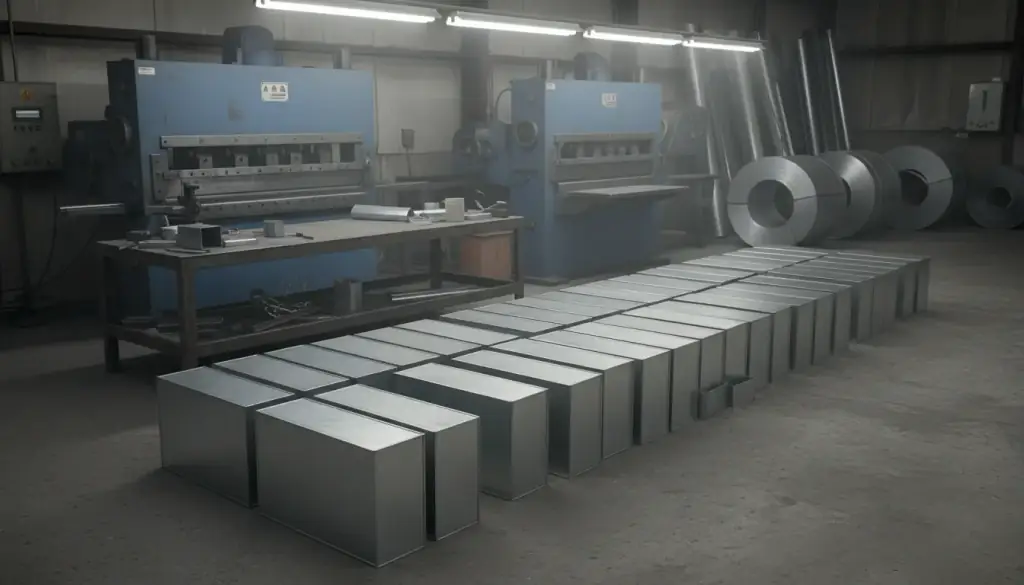
Most HVAC companies the size of Certified Inc buy ductwork fittings off a shelf and cut the job to fit them. We do not, because we run our own 6,000 square foot sheet metal shop behind the service trucks, and that changes what an install looks like in a house that was never built on a straight line.
What is actually back there
The shop fabricates and welds sheet metal from light gauge material up through thick steel plate, in aluminum, copper, galvanized steel, colored steel and stainless. Brent Thompson leads the team that runs it, and between the shop crew and the estimators the service group carries more than a hundred years of combined mechanical trade experience. It is not a side operation. It is a working fabrication floor that exists because a lot of the jobs this shop takes on cannot be solved with parts off a shelf.
What a brake and a Pittsburgh lock actually are
A brake is the machine that bends flat sheet metal to a precise angle, the way you would fold a piece of paper except the fold has to hold its shape under pressure and last decades. A Pittsburgh lock is a mechanical seam, a folded edge on one piece of duct that hooks into a matching folded edge on the next piece, closing the joint without screws or rivets and without relying on sealant alone to hold. Both are standard fabrication techniques, but doing them in-house, to the exact dimension a specific job calls for, is the difference between ductwork built for this house and ductwork built for a catalog size and then coaxed to fit.
Why the material changes with the job
The shop works in aluminum, copper, galvanized steel, colored steel and stainless, and which one goes into a job is not a style choice, it is a fit choice. Galvanized is the standard for most residential duct runs, light, workable and durable for the job it does. Stainless goes where corrosion resistance actually matters, a kitchen exhaust run or a commercial application with moisture or chemical exposure the galvanized coating was not built to handle. Copper and colored steel come up on the flashing and exposed architectural work where the finished appearance is part of the job, not just what is behind a wall. Running light gauge material up through thick steel plate in the same shop means a job that needs a delicate residential transition and a job that needs a heavy commercial fire-rated component both get built by the same team, to the gauge and material the job actually calls for, rather than whatever happens to be sitting on a supplier's shelf.
Why that matters in a house with no straight runs
A house built in the 1920s was not built with duct runs in mind. Joists sit where they sit, a chimney chase takes up the one straight path through the middle of the house, and a basement ceiling has less headroom in one corner than another. Off-the-shelf fittings assume standard angles and standard transitions, and a retrofit into a house like that usually means either forcing a shelf part into a space it was not designed for, with extra joints and elbows that restrict airflow and invite leaks, or custom-fabricating the one piece that actually solves the transition cleanly. We build the second option, cut to on-site dimensions, rather than adapting a catalog part.
It shows up in more than the ductwork
The same shop that fabricates a custom transition fitting for a 1920s basement also builds the sheet metal enclosures, custom flashing and fire-rated components that come up on commercial jobs, hospitals, schools and manufacturing sites among them. Design-build heating projects, certified fire dampening and ventilation work all draw on the same shop floor. It is the same reason a homeowner with an oddly shaped attic and a commercial client with a code-driven fire damper requirement end up calling the same number.
What it means for your install
If your house has a layout that makes a standard duct run awkward, a low ceiling, an old chimney chase, a retrofit into a room that was never conditioned before, that is exactly the kind of job the sheet metal shop exists for. It usually means a cleaner-looking install, fewer joints for air to leak out of, and a fitting built for your house rather than adapted to it.
See it for yourself
We are happy to walk you through what the shop can build for a specific retrofit before you commit to anything. Estimates are free, and any ductwork we fabricate and install carries the same one-year workmanship warranty as the rest of our work. Call (715) 834-5409, or stop by 350 Sunday Drive in Altoona.
Certified Inc, (715) 834-5409
Call (715) 834-5409More articles
Why a furnace usually quits on the coldest night of the year
The failure is rarely instant. Here is what the furnace is telling you two weeks before it quits, and what to check yourself before you call.
Hard water, orange stains and blue-green joints: reading what your well is doing to the house
Three symptoms in three different rooms are usually the same well telling you three different things.